Generating enthusiasts in the decorative and graphic arts and architecture throughout Europe and beyond, Art Nouveau appeared in a wide variety of strands, and, consequently, it is known by various names, such as the Glasgow Style, or, in the German-speaking world, Jugendstil. Art Nouveau was aimed at modernizing design, seeking to escape the eclectic historical styles that had previously been popular. Artists drew inspiration from both organic and geometric forms, evolving elegant designs that united flowing, natural forms resembling the stems and blossoms of plants. The emphasis on linear contours took precedence over color, which was usually represented with hues such as muted greens, browns, yellows, and blues. The movement was committed to abolishing the traditional hierarchy of the arts, which viewed the so-called liberal arts, such as painting and sculpture, as superior to craft-based decorative arts. The style went out of fashion for the most part long before the First World War, paving the way for the development of Art Deco in the 1920s, but it experienced a popular revival in the 1960s, and it is now seen as an important predecessor - if not an integral component - of modernism.
[ Vincent Van Gogh ]
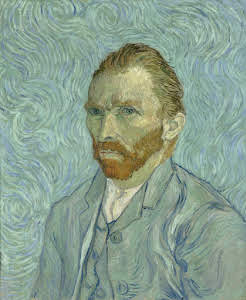 Vincent van Gogh (1853-1890), perhaps the most famous artist in the world, is perceived by many as the 'mad' artist, the
man who painted in a frenzy or simply the tormented soul who cuts off his ear. His artistic genius is often overshadowed
by those who see his paintings as mere visual manifestations of his troubled mind. Whilst in part this may be true, in
reality his innovative and unique artistic style was of enormous importance to a host of artists who followed in his
wake. Even when openly influenced by his predecessors or contemporaries his art remained identifiably his own,
developing a distinctive style that failed to be accepted by the art-buying public in his own time. The career of
Vincent van Gogh as a painter was short, but his paintings revolutionized artistic practice and styles. The intensity of
his vision, his wonderful sense of color, and the extraordinary boldness of his technique created masterpieces that
exercise a profound influence on the art of the twentieth century.
Vincent van Gogh (1853-1890), perhaps the most famous artist in the world, is perceived by many as the 'mad' artist, the
man who painted in a frenzy or simply the tormented soul who cuts off his ear. His artistic genius is often overshadowed
by those who see his paintings as mere visual manifestations of his troubled mind. Whilst in part this may be true, in
reality his innovative and unique artistic style was of enormous importance to a host of artists who followed in his
wake. Even when openly influenced by his predecessors or contemporaries his art remained identifiably his own,
developing a distinctive style that failed to be accepted by the art-buying public in his own time. The career of
Vincent van Gogh as a painter was short, but his paintings revolutionized artistic practice and styles. The intensity of
his vision, his wonderful sense of color, and the extraordinary boldness of his technique created masterpieces that
exercise a profound influence on the art of the twentieth century.
[ Georges-Pierre Seurat ]
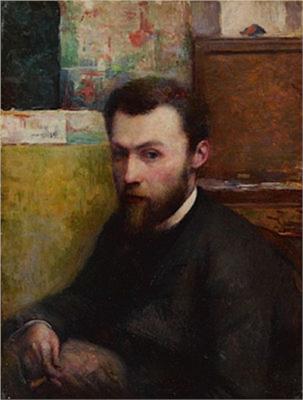 Georges-Pierre
Seurat (2 December 1859 – 29 March 1891) was a French post-Impressionist painter and draftsman. He is
noted for his innovative use of drawing media and for devising the painting techniques known as chromoluminarism
and
pointillism. Seurat's artistic personality was compounded of qualities which are usually supposed to be opposed
and
incompatible: on the one hand, his extreme and delicate sensibility; on the other, a passion for logical
abstraction and
an almost mathematical precision of mind. His large-scale work, A Sunday Afternoon on the Island of La Grande
Jatte
(1884–1886), altered the direction of modern art by initiating Neo-impressionism, and is one of the icons of
late
19th-century painting.
Georges-Pierre
Seurat (2 December 1859 – 29 March 1891) was a French post-Impressionist painter and draftsman. He is
noted for his innovative use of drawing media and for devising the painting techniques known as chromoluminarism
and
pointillism. Seurat's artistic personality was compounded of qualities which are usually supposed to be opposed
and
incompatible: on the one hand, his extreme and delicate sensibility; on the other, a passion for logical
abstraction and
an almost mathematical precision of mind. His large-scale work, A Sunday Afternoon on the Island of La Grande
Jatte
(1884–1886), altered the direction of modern art by initiating Neo-impressionism, and is one of the icons of
late
19th-century painting.
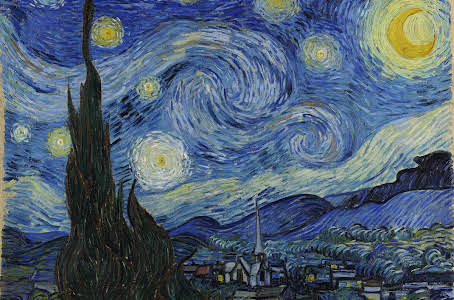
The Starry Night-V
1889
=> Starry Night depicts a dreamy interpretation of the artist's asylum room's sweeping view of Saint-Rémy-de-Provence.
Though Van Gogh revisited this scene in his work on several occasions, "Starry Night" is the only nocturnal study of the
view. Thus, in addition to descriptions evident in the myriad of letters he wrote to his brother, Theo, it offers a rare
nighttime glimpse into what the artist saw while in isolation. "Through the iron-barred window I can make out a square
of wheat in an enclosure," he wrote in May of 1889, "above which in the morning I see the sunrise in its glory."
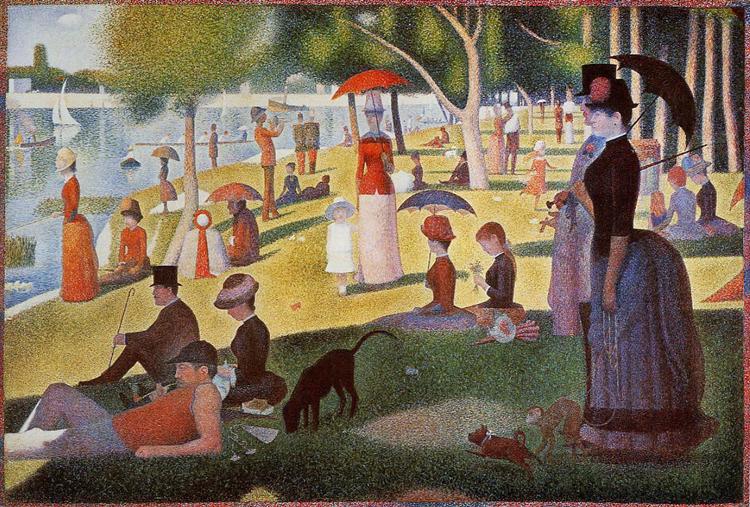
Sunday Afternoon-G
1884-1886
=> This most famous and influential Neo-Impressionist work depicts a cross-section of Paris society enjoying a Sunday
afternoon in the park on an island in the Seine River just at the gates of Paris. Sunday was the time that middle-class
Parisians escaped the city to enjoy the outdoors. The people primarily gather in small groups of two or three or sit
alone in proximity to others. It is the relationship between these people that creates a sense of modernity, with its
distance and disconnection, and nervous tension that lends the work an air of mystery.
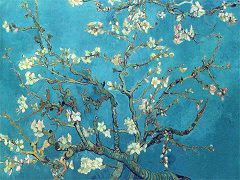
Almond-blossom-V
1890
=> Almond Blossom was painted immediately before one of his attacks; "My work was going well," he informed his brother,
"the last canvas of branches in blossom - you will see that it is perhaps the best, the most patiently worked thing I
had done, painted with calm and with greater firmness of touch. And the next day, down like a brute." Poised between
lucidity and desperation, this lacework of light and color is kept aloft by the confidence Van Gogh had acquired in the
previous two or three years and the sheer technical finesse now at his command.
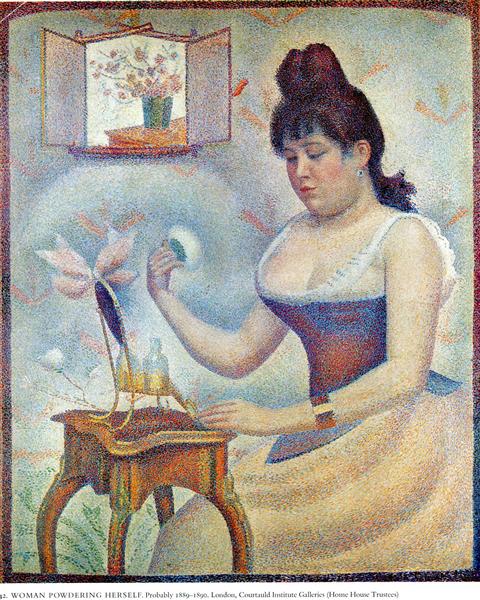
Young woman makeup-G
1889-1890
=> Jeune femme se poudrant (Young Woman Powdering Herself) is a circa 1889-90 painting by French painter Georges Seurat.
The work depicts his mistress Madeleine Knobloch.
Seurat kept his relationship with artist's model Knobloch secret. His relationship to the sitter was concealed when it
was exhibited in 1890.
Musée d'Orsay,Prais-V
1890
=> The Church at Auvers - along with other canvases such as The Town Hall at Auvers and several paintings of small houses
with thatched roofs - is reminiscent of scenes from the northern landscapes of his childhood and youth. A certain
nostalgia for the north had already been apparent in his last weeks at Saint-Rémy-de-Provence: in a letter written a
couple of weeks before his departure, he wrote "While I was ill I nevertheless did some little canvases from memory
which you will see later, memories of the North"

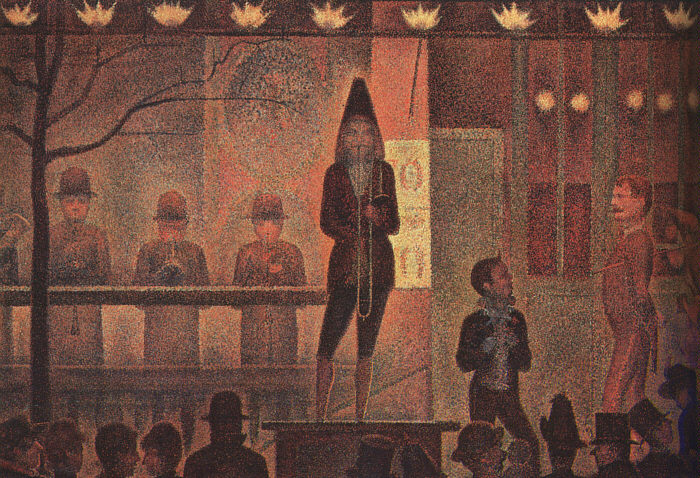
Circus sideshow-G
1890
=> Circus Sideshow is a large oil painting on canvas measuring 99.7 × 149.9 centimetres (39.3 × 59.0 in). Painted in the
Divisionist style, the work employs pointillist dots of color (primarily violet-gray, blue-gray, orange, and green) and
a play of lines governed by rules whose laws Seurat had studied. It depicts immobile figures outdoors under artificial
lighting at the sideshow of the Circus Corvi at place de la Nation, a working-class quarter in eastern Paris. A row of
cornet and trombone players in solemn formation are seen under the unreal evening lights of a parade. The work is
dominated by a monotony of horizontal and vertical lines, suggesting the rhythms of Egyptian reliefs and frescoes.
Though rather than indicating distance as Egyptian art (by changing scale), or classically (by foreshortening), Seurat
establishes the position of his subjects through lighting. Those in the foreground are unlit, painted in dark blue,
while those behind the gas jets are brilliantly lit.
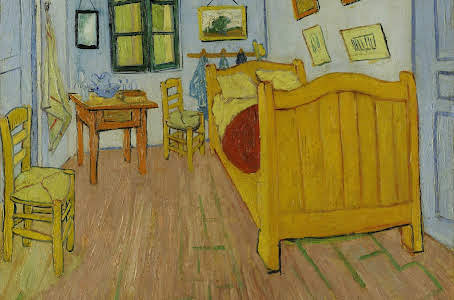
The Bedroom At Arles-V
1888
=> In The Bedroom at Arles this movement is sustained by a delightful, inventive play of scattered objects. As we follow
the converging lines of the floor and bed to an unmarked point, we come to a rival perspective system in the dark lines
of the casements, of which the repeated angles occur again in a series of surrounding objects of different color and
complexity: the distant chair and table, the picture wires, the ceiling corner, and the inclined pictures at the right.
Together they form a free pattern of zigzags across space, flattened and softened in the wavy lines of the bed boards.
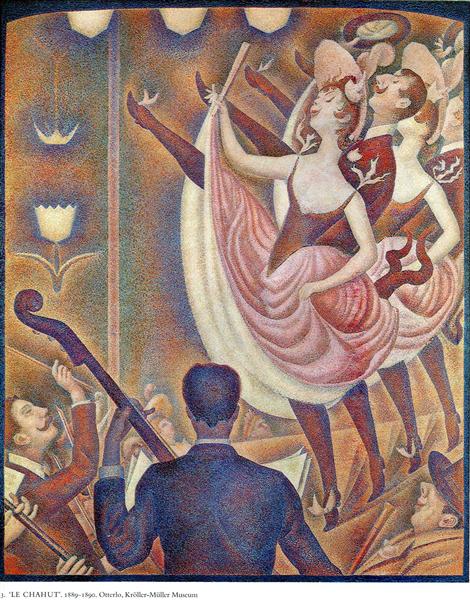
Chahut-G
1889-1890
=> Le Chahut (English: The Can-can) is a Neo-Impressionist painting by Georges Seurat, dated 1889-90. It was first
exhibited at the 1890 Salon de la Société des Artistes Indépendants (titled Chahut, cat. no. 726) in Paris, where it
eclipsed other works. Chahut became the prime target of art critics, and was widely discussed among Symbolist critics.
Wheatfield with crows
1888
=> Wheatfield with Crows is one of Van Gogh's re-created memories of the north, and is believed to be the last work of Van
Gogh. In early July of 1890, Van Gogh traveled to Paris, alone, to stay with Theo and his wife Jo. Theo was in poor
health and was having financial problems, which was an enormous worry to Van Gogh who was keenly aware of the burden he
was on his brother and his family. In addition, the baby was ill and Jo too was suffering from exhaustion. Van Gogh
returned quickly to Auvers but rapidly became severely depressed. Writing of this picture shortly before his suicide,
Van Gogh conveyed something of its tragic mood: "Returning there, I set to work. The brush almost fell from my hands...I
had no difficulty in expressing sadness and extreme solitude".